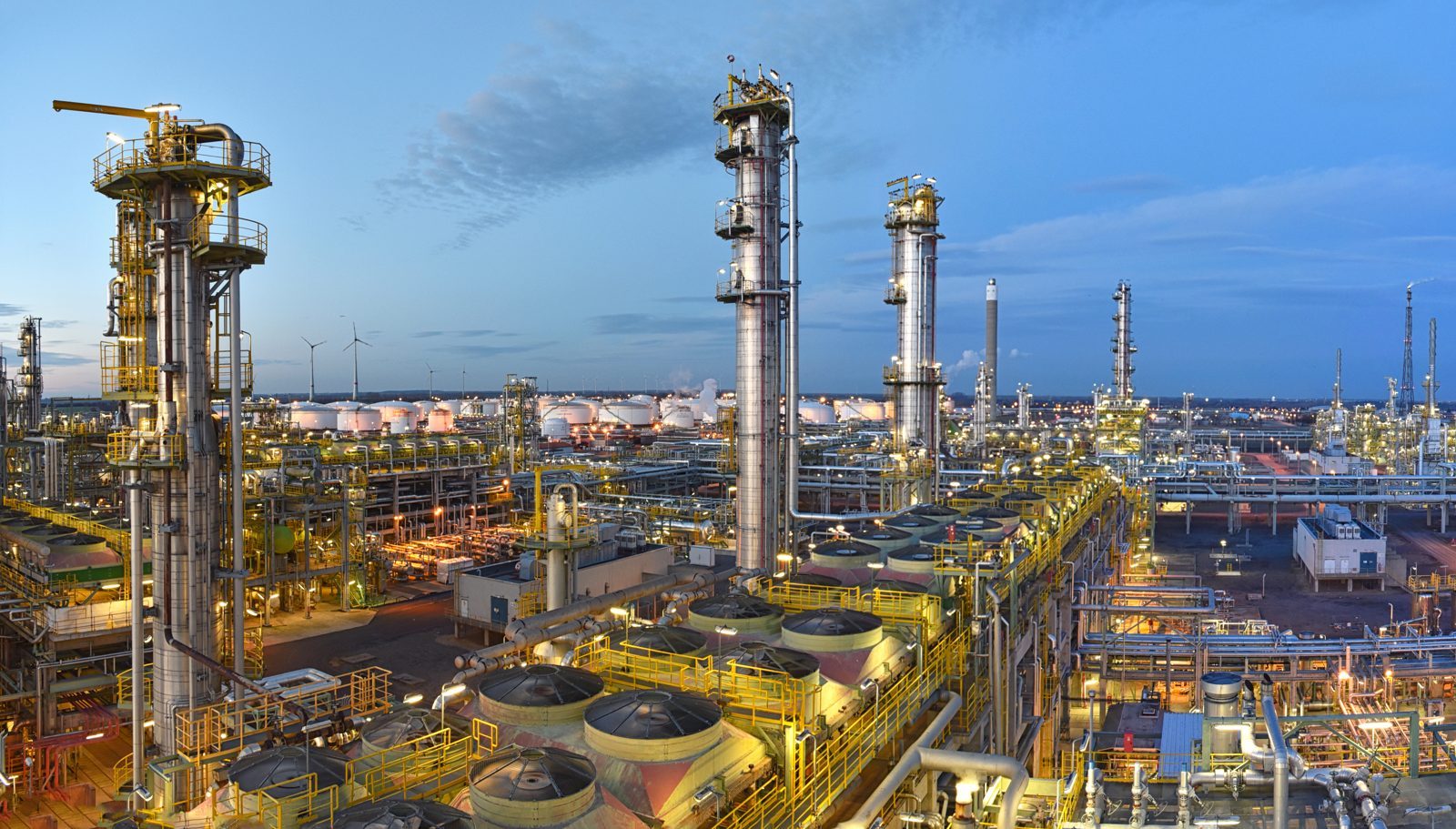
Upstream uptime, downstream turnaround, refinery yield. Asset-intensive, capex-heavy, regulated, where every shift sets the year-end number.
Oil and gas runs on a value chain where every interface is regulated and every hour an asset sits down reads back to the year-end number. Reservoir to refinery to retail, with a turnaround calendar in between. Proudfoot has installed at depth in oil and gas across upstream production, downstream refining, integrated petrochemicals, midstream, and well services. The discipline holds across the platform, the refinery, the pipeline, and the turnaround.
Where the value lives, and where it leaks.
Oil and gas is a value chain where every interface is regulated and every hour an asset sits down reads back to the year-end number. Reservoir to refinery is the long form: drilling and well services feed upstream production, upstream production feeds the gathering system, the gathering system feeds the pipeline or the FPSO, the pipeline or the FPSO feeds the terminal, the terminal feeds the refinery, the refinery feeds the petrochemical integration or the product slate, and the product slate feeds the customer through midstream logistics and retail. Each interface is regulated by safety, environment, integrity, and a tax-and-royalty regime that touches every barrel and every cubic foot. Variability at any one of those interfaces compounds across the chain, and the cost of error is not waste alone but production deferral, integrity, and license-to-operate.
The cost of error in oil and gas is measured in three currencies that compound on every shift. Asset hours, where a platform off-line for unplanned maintenance, a refinery unit down for an unscheduled trip, or a pipeline tripped at a station all read directly to production deferral and to the AOG-equivalent maths the operator runs on revenue per hour. Yield, where a refinery's premium product slate, a unit's recovery against feedstock, and a turnaround's plan-versus-actual all decide whether the year hits the number; the difference between the run-rate the design promises and the run-rate the operation delivers is the largest single value lever in downstream. Integrity and safety, where every barrel of crude, every cubic foot of gas, every welded joint, and every operator hand on the line is bounded by process safety management, the regulator's standard, and the contract with the workforce; the consequence of poor practice is harm and license loss, not waste.
Frontline supervision is the lever that holds the chain together. An oil and gas operation runs on dispersed crews, multiple shifts, complex equipment estates, and a span of control that stretches a supervisor across a platform deck, a refinery unit, a pipeline section, or a multi-pad upstream field. The discipline that keeps the chain intact is the supervisor at the unit, the planner reading variance against the maintenance and turnaround plan, the operator executing standard work to the procedure, the millwright running the planned shutdown to schedule, and the turnaround manager holding the contractor and the operator to the same critical-path. The Proudfoot work in oil and gas lands at that point.
Through analysis, strategy, and design, the plan looks the same on every operator's desk. Execution is where the money is made. The gap between a credible turnaround plan and the turnaround the crew actually runs, and between the yield a unit is rated for and the yield it holds on a Tuesday night shift, is the value, and it is closed only on the frontline. Energy is the clearest case: on a refinery it can run at close to 60% of operating cost, and it is governed less by the asset than by the thousands of daily operating decisions made by the people who run it. Behavior change at that level, held by the supervisor and the operating cadence, is where the downstream margin sits. Proudfoot installs the discipline at the point of execution, on the unit and at the planner’s desk, and stays until the operator holds it without us.

Where the discipline lands.
Upstream
Offshore platforms (FPSOs, fixed installations, subsea-tieback satellites), onshore production fields, drilling operations, and well intervention. Production deferral discipline, planned maintenance execution at depth, supervisory cadence on the platform deck and the well pad, multi-skilling against the certified-trade rota.
Midstream
Pipelines, gathering networks, terminals, storage, and LNG. Integrity management against regulator and insurer scrutiny, planned versus unplanned outage discipline, terminal throughput against the loading window, and the operating cadence that keeps the line and the tank inside specification.
Downstream
Refining, petrochemicals integration, blending, and product distribution. Refinery yield against the design slate, complexity index against the crude tolerance, unit availability against the planned cycle, and the supervisory cadence on the unit, in the control room, and at the planner's desk that keeps the run-rate at plan.
Turnaround and shutdown execution
Planning, mobilisation, and recovery on multi-million-dollar refinery and platform turnaround events. Front-end loading discipline, scope freeze against contingency, contractor coordination on the critical-path, and the daily and weekly operating cadence that runs the turnaround as an operation rather than as a project.
Well services and operating partnerships
Where the operator runs the asset and Proudfoot installs the operating system that makes the partnership measurable on both sides. Performance academy build, supervisory uplift across multi-region service portfolios, maintenance excellence diagnostics, and the partnership cadence that holds productivity gains across multi-year service contracts.

Four capabilities oil and gas COOs recognize.
Increase Throughput
Refinery yield against the design slate, unit availability against the planned cycle, recovery against feedstock, and the daily run-rate at plan. Most downstream throughput gains land at the unit and the control room, where short interval control on the shift reduces the gap between nameplate and run-rate, and where the supervisor's daily cadence holds the gains the planner has scheduled. The same logic carries into upstream production deferral and midstream throughput at the terminal.
Improve Productivity
Turnaround discipline at the heart, plus frontline supervision on the platform deck, in the unit, and at the well pad, and standard work executed to the procedure. Turnaround productivity is the single largest controllable cost in downstream and a step-change opportunity on every multi-year cycle: front-end loading at scope freeze, planning to the critical-path, contractor coordination held against the daily and weekly operating cadence, and supervisory uplift across the turnaround crew.
Improve Asset Utilization
Uptime against the planned cycle, planned versus unplanned downtime, reliability-centred maintenance on the rotating estate, and asset availability against design rate. The oil and gas asset is the largest single capital base on most operations; small uplifts compound across the platform, the unit, and the pipeline. Production deferral discipline upstream, refinery unit reliability downstream, terminal availability midstream, and integrity management across the regulated estate carry the long tail of the value.
Optimize CAPEX
Capital project recovery on platform installation, refinery debottlenecking, brownfield expansion, and greenfield project execution. The work installs the same operating discipline on a project site as on a frontline: short interval control, daily and weekly cadence, frontline supervision, contractor coordination, and a measured base case the project is run against. The multi-billion-dollar capital programs that drive the asset's lifetime cost run on the same operating discipline that runs the production day.
Production. Asset Management. Construction.
Production
The unit, the platform, the frontline, the daily operating rhythm against the production plan. Yield, throughput, recovery against feedstock, complexity index, shift discipline, frontline supervision.
Asset Management
Refinery unit reliability, platform maintenance, pipeline integrity, planned shutdown design, planning and scheduling, turnaround execution at the heart, and the supervisory cadence that holds the asset estate intact. The right work, on the right asset, at the right interval, executed to the procedure.
Construction
Platform installation, refinery debottlenecking, brownfield expansion, greenfield project execution, contractor coordination on the critical-path, and capital project recovery on multi-billion-dollar capital programs.
The method behind the work.
The Proudfoot System runs the engagement, end to end across 5 phases and 86 steps, sized to the turnaround scope and the production window. Three components carry the oil and gas work: front-end loading discipline, the operating cadence that runs the turnaround as an operation, and the supervisor behaviors that hold the safe operating envelope.
The Proudfoot MOS (the 6+4 Element Framework) is the operating discipline that makes the capabilities deliverable. The discipline has been installed at depth across the oil and gas value chain: at downstream refineries in Europe, North America, and South-East Asia, on integrated petrochemicals operations across the Gulf of Mexico, North-West Europe, and the United States Gulf Coast, on upstream production fields across West Africa, North America, and the North Sea, at multi-region well services and operating-partnership portfolios across the United Kingdom, Asia-Pacific, and Australia, and on capital project programs across major oil and gas operating centers. It has held in the unit and the control room, on the platform deck and at the well pad, in the turnaround scope freeze and on the critical-path, and on the brownfield and greenfield frontline.
The 8 Active Management Behaviours (8AMBs) are the supervisory behaviors that make the operating discipline stick. Observable on the unit operator's daily routine, the platform deck supervisor's tour, the turnaround manager's morning huddle, the planner-supervisor handover at shift change, the millwright tool-box talk on the planned shutdown, and the control-room hand-back to operations. Codified, coachable, repeatable. Aerial Mapping is the structured executive interview discipline that surfaces the value at the start of the engagement, across the asset GM, the head of operations, the head of maintenance and reliability, the head of turnaround, the head of HSE and process safety, the head of supply chain and logistics, and on multi-asset estates the regional or function operations leader.
Talk to our oil and gas partners.
Multi-region energy services and operating-partnership work, including offshore project support, performance academy build, and maintenance excellence across the United Kingdom, Asia-Pacific, and Australia.
Upstream Africa including offshore and onshore production, acquisition-led OPEX, and operating-system installation across multi-asset upstream portfolios.
North American downstream refining including planning and scheduling discipline, plus the refinery and petrochemicals integration interface across the Americas.

Five days on the frontline. One decision at the end.
Two senior Proudfoot operators on a priority site for five working days, with Proudfoot AI reading the operating data and the corpus first, remotely. Walkthrough, executive interviews, day-in-the-life-of observation on the supervisor, the planner, and the turnaround manager, MOS Critic on the management system, and a quantified opportunity hypothesis prioritized by lever. Decision-grade material in a week, sized to the operation.
Frequently asked questions about Proudfoot in oil and gas
Proudfoot installs the management operating system that makes frontline supervision measurable, coachable, and repeatable. In oil and gas the work focuses on refinery yield, unit availability, turnaround execution, planned maintenance, production deferral discipline, and capital project schedule attainment. The same operating discipline runs across upstream, midstream, downstream, turnaround and shutdown execution, and well services and operating partnerships.
Upstream (offshore platforms, onshore production, drilling operations, and well intervention), midstream (pipelines, gathering networks, terminals, storage, and LNG), downstream (refining, petrochemicals integration, blending, and product distribution), turnaround and shutdown execution on multi-million-dollar refinery and platform events, and well services and operating partnerships where the operator runs the asset and Proudfoot installs the operating system that makes the partnership measurable on both sides.
Results include $9.2m in annualised savings at a North American downstream refining and integrated retail operator, premium product release lifted from 13% to 17% and sour crude improvement from 19% to 31% at that operation, a turnaround value creation program on a complex multi-unit Eastern European refinery, production deferral discipline embedded across a West African upstream portfolio following an acquisition-led OPEX program, and an operating-partnership cadence installed across a multi-region energy services portfolio.
Proudfoot runs the turnaround as an operation rather than as a project: front-end loading discipline, scope freeze against contingency, contractor coordination on the critical-path, and the daily and weekly operating cadence that holds the plan against actual. Supervisory cadence on the unit and at the planner's desk is codified against the eight Active Management Behaviours and held by trained turnaround managers after the engagement closes.
Two senior Proudfoot operators spend five working days on your priority site, with Proudfoot AI reading the operating data and the corpus first, remotely. The output includes a walkthrough, executive interviews, day-in-the-life-of observation on the supervisor, the planner, and the turnaround manager, a management system critique, and a quantified opportunity hypothesis prioritized by lever. Decision-grade material in a week, sized to the operation.